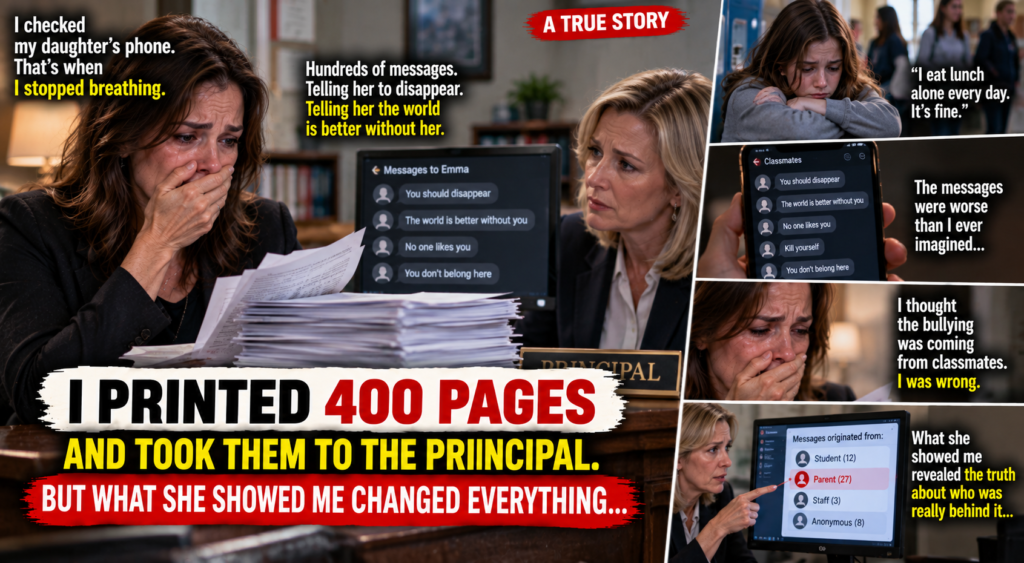
I Printed 400 Pages of Messages Sent to My Daughter
A true story.
At least, that’s what it felt like to me.
The school principal was called.
Then the teacher, who was quiet but reassuring, said:
“She’s fine.”
I stared at her.
“She eats lunch alone every day.”
The teacher gave me a small smile.
“She’s quiet, but okay.”
Okay.
That word stayed in my head.
My daughter, Emma, had never been the loudest kid in the room.
She was shy.
She loved drawing.
She preferred books to parties.
And she had always been the kind of child who would rather sit quietly in a corner than ask for help.
So when she started coming home from school and going straight to her bedroom, I assumed she was simply tired.
When she stopped asking for sleepovers, I thought she was growing up.
When she started saying, “I’m fine,” more often, I believed her.
Then one night, I looked at her phone.
I wasn’t searching for secrets.
I was searching for an explanation.
What I found made me stop breathing.
Hundreds of messages.
From classmates.
From anonymous accounts.
Some were cruel.
Some were humiliating.
And some told my daughter that everyone would be better off without her.
I sat on the edge of her bed, staring at the screen.
My hands were shaking.
“Emma…”
She looked at me.
“What?”
“Who is sending these?”
She immediately started crying.
“I don’t know.”
“How long has this been happening?”
She wiped her face.
“A while.”
“How long?”
She whispered:
“Almost six months.”
Six months.
My daughter had been carrying this alone for six months.
I felt sick.
I asked her why she hadn’t told me.
She looked down.
“Because they said it would get worse if I told.”
That night, I didn’t sleep.
I screenshot everything.
Every message.
Every account.
Every threat.
Every photograph.
Every time someone had told her she didn’t belong.
By morning, I had hundreds of screenshots.
I printed them.
Page after page.
The printer ran for hours.
When it finally stopped, I counted the stack.
Four hundred pages.
I put them into a box.
Then I drove to the school.
The next morning, I walked into the principal’s office and set the stack on her desk.
She stared at it.
Then she looked at me.
“Mrs. Harper…”
I said nothing.
She touched the first page.
“How long?”
“Six months.”
Her expression changed.
“We’ve spoken to Emma’s teacher.”
“I know.”
“She told us Emma was quiet but doing fine.”
“She wasn’t fine.”
The principal looked down.
“I understand.”
“No,” I said.
“I don’t think you do.”
I opened the box.
“These aren’t one or two messages.”
I pushed the pages toward her.
“This is hundreds.”
She began flipping through them.
Her face became increasingly serious.
Then she stopped.
She looked at me.
“Mrs. Harper, before you say anything…”
She turned her computer screen toward me.
“There’s something I need to show you.”
I looked at the screen.
And what I saw made me realize the bullying wasn’t coming from where I thought.
The principal opened a report.
It showed the accounts that had been reported.
Then she opened another screen.
“This is the activity log our technology department was able to recover.”
I leaned closer.
I expected to see a list of students.
Instead, I saw something completely different.
The messages weren’t coming from Emma’s classmates.
At least, not primarily.
Most of the anonymous accounts had been created from outside the students’ usual devices.
Some had been accessed late at night.
Some were being managed from the same small group of internet connections.
And then the principal pointed to one account.
“This one.”
I stared at the username.
It wasn’t a student’s name.
It wasn’t anonymous anymore.
It was connected to an adult.
I looked at her.
“Who is that?”
She took a breath.
“A parent volunteer.”
I couldn’t believe it.
“Why would a parent do this?”
“We don’t know yet.”
She opened another file.
“There’s more.”
The messages weren’t random.
They were targeting Emma because of something that had happened at school months earlier.
A rumor.
Someone had accused Emma of reporting cheating during a group project.
The rumor spread.
Then another rumor appeared.
Someone claimed Emma had gotten another student in trouble.
Neither was true.
But the rumors had become a story.
And the story had become permission for people to be cruel.
The principal looked at me.
“We originally believed the harassment was student-on-student bullying.”
“So did I.”
“But our investigation changed that.”
She opened another document.
“This adult appears to have encouraged several students to pile on.”
My stomach dropped.
“Why?”
The principal hesitated.
“We believe she was angry because her son was one of the students involved in the original incident.”
I remembered the boy.
Lucas.
A popular student.
His mother had attended nearly every school event.
She had always been friendly to me.
She had smiled at Emma.
She had even complimented Emma’s artwork once.
I couldn’t believe it.
“Are you telling me an adult was behind this?”
“We’re still investigating.”
“But you have evidence.”
“Yes.”
I looked at the four hundred pages on the desk.
“Then why did nobody notice?”
The principal looked ashamed.
“Because the messages were designed to look like they came from students.”
She paused.
“And because Emma didn’t report them.”
I shook my head.
“She didn’t report them because she was afraid.”
“I know.”
“And because every adult she spoke to told her she was fine.”
The principal lowered her eyes.
“You’re right.”
That sentence was the first apology I heard.
But it wasn’t enough.
I wanted answers.
The school opened a formal investigation.
They interviewed students.
Parents.
Teachers.
Technology staff.
They reviewed messages.
They reviewed account activity.
They compared timestamps.
And slowly, the truth came together.
The adult wasn’t acting alone.
She had been encouraging several students to send messages from their own accounts while also using anonymous accounts herself.
She had told them Emma deserved it.
She had convinced them that Emma had caused trouble for their children.
And because the students were afraid of getting in trouble, some of them participated.
Others simply watched.
A few had even forwarded messages without understanding how far things had gone.
The principal called another meeting.
This time, the school district’s legal representative was present.
So was the school counselor.
And so was Emma.
I didn’t want her there.
But Emma insisted.
“I want to hear them say it.”
So we sat together.
The principal began.
“We have completed the initial investigation.”
She looked at Emma.
“What happened to you was serious.”
Emma stared at the floor.
“You were not responsible for the harassment.”
Emma’s eyes filled with tears.
The principal continued.
“We found evidence that several students participated.”
Then she looked at me.
“And we found evidence that an adult encouraged and facilitated some of the harassment.”
Emma looked up.
“Who?”
The principal paused.
“The school cannot discuss another student’s family in detail while the investigation is ongoing.”
Emma’s face fell.
But I understood.
This wasn’t about revenge.
It was about stopping it.
The school suspended the students involved according to its disciplinary policies.
The parent volunteer was removed from all school activities while the investigation continued.
The district also contacted the appropriate authorities because some of the messages crossed serious legal and safety boundaries.
But there was something I cared about even more.
Emma.
She had spent six months believing that she was the problem.
We started counseling.
Not because there was something wrong with her.
Because something had been done to her.
Her counselor taught her that being quiet wasn’t weakness.
That asking for help wasn’t betrayal.
And that someone else’s cruelty wasn’t evidence of her worth.
The school also changed its reporting process.
Students could report harassment anonymously.
Teachers received training on recognizing social isolation.
And the school created a system for escalating repeated online harassment instead of treating each message as an isolated incident.
But the most important change happened inside our house.
I stopped asking Emma:
“Are you okay?”
Instead, I started asking:
“What happened today?”
Sometimes she talked.
Sometimes she didn’t.
I learned to sit beside her without forcing her to speak.
One afternoon, months later, she came into the kitchen.
“Mom?”
“Yes?”
“Can I ask you something?”
“Anything.”
“Did you really print all of them?”
I smiled.
“Yes.”
“Four hundred pages?”
“Four hundred.”
She laughed for the first time in a long time.
“That must have used a lot of paper.”
“It did.”
She smiled.
Then she said:
“I thought you were going to be angry with me.”
I froze.
“Why?”
“Because I didn’t tell you.”
I walked over and hugged her.
“Emma, I could never be angry at you for being scared.”
She started crying.
“I thought nobody would believe me.”
“I believe you.”
She buried her face in my shoulder.
“I should have told you sooner.”
I held her tighter.
“You told me when you were ready.”
That was the moment I realized something.
The four hundred pages weren’t just evidence.
They were four hundred pages of pain that my daughter had been carrying silently.
I couldn’t erase them.
But I could make sure she never had to carry something like that alone again.
A year later, Emma’s life looked different.
She still liked drawing.
She still preferred quiet places.
She still wasn’t the loudest person in the room.
But she started making friends again.
She joined an art club.
She began eating lunch with two other girls.
She even entered a local art competition.
Her painting won second place.
When she came home with the certificate, she smiled so widely that I almost cried.
“Mom!”
“What?”
“I won!”
I hugged her.
“I knew you could.”
She looked at the certificate.
Then at me.
“Do you remember when I didn’t want to go back to school?”
“Yes.”
“I don’t feel like that anymore.”
I smiled.
“I’m proud of you.”
She nodded.
Then she said:
“I think I’m proud of me too.”
That sentence meant more to me than any apology from the school ever could.
The investigation eventually concluded.
The adults involved faced consequences.
The students involved were disciplined.
The school acknowledged that it had failed to recognize the severity of what Emma was experiencing.
The principal apologized to me personally.
“I should have looked deeper,” she said.
I nodded.
“Yes.”
She looked at Emma.
“And I should have listened to you.”
Emma didn’t answer.
She didn’t have to.
Sometimes an apology doesn’t need a response.
Sometimes it simply needs to be followed by change.
I still have the four hundred printed pages.
I keep them in a box in the back of my closet.
Not because I want to remember the cruelty.
Because I want to remember the moment I stopped assuming that “quiet” meant “fine.”
Whenever someone says:
“She doesn’t seem upset.”
I think about Emma.
Whenever someone says:
“Kids are just being kids.”
I think about those pages.
And whenever someone says:
“She would have told us if something was wrong.”
I remember how terrified my daughter was to speak.
Children don’t always ask for help in obvious ways.
Sometimes they become quiet.
Sometimes they stop eating lunch with friends.
Sometimes they stop asking to go to school.
Sometimes they say:
“I’m fine.”
And sometimes “I’m fine” means:
“I don’t know how to tell you that I’m hurting.”
That is why I printed those four hundred pages.
Not to destroy anyone.
Not to get revenge.
But to make sure somebody finally listened.
And if there is one thing I hope every parent remembers, it’s this:
When your child says they’re fine, don’t always accept the first answer.
Sit beside them.
Ask again.
Listen carefully.
Look for the things they aren’t saying.
Because sometimes the quietest child in the room is carrying the loudest pain.
And sometimes all they need…
is one person to finally believe them.