I Traded an Entire Hour of My Life for Gas, Milk, and Eggs
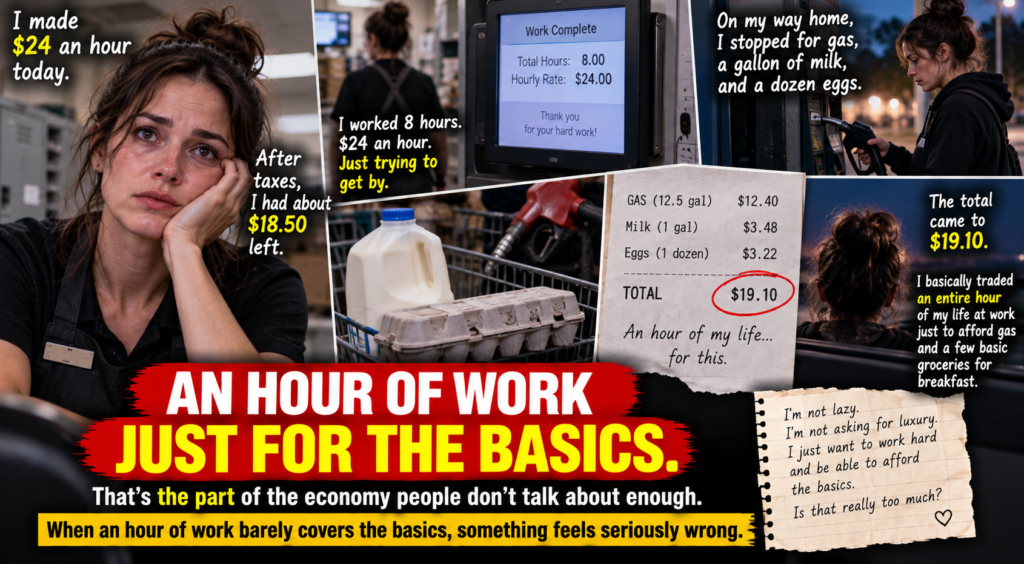
I made $24 an hour today.
After taxes, I had about $18.50 left.
On my way home, I stopped for gas, a gallon of milk, and a dozen eggs.
The total came to $19.10.
I stood at the checkout counter staring at the receipt.
Nineteen dollars and ten cents.
I had just worked an entire hour of my life…
just to afford gas and a few basic groceries for breakfast.
I wasn’t buying steak.
I wasn’t buying a bottle of wine.
I wasn’t ordering takeout.
I wasn’t shopping for anything unnecessary.
Gas.
Milk.
Eggs.
That was it.
And somehow, I had spent more money than I had earned in an hour after taxes.
I walked back to my car carrying the groceries.
For a few seconds, I just sat behind the steering wheel.
I didn’t start the engine.
I looked at the receipt again.
$19.10.
Then I looked at my gas gauge.
Almost empty.
I laughed.
Not because it was funny.
Because sometimes the only alternative to crying is laughing.
I had spent an hour working just to buy enough fuel to get back to work.
And that was the part of the economy people don’t talk about enough.
It’s not always about luxury.
It’s not always about people wanting bigger houses or expensive vacations.
Sometimes it’s about someone working full-time and still having to calculate whether they can afford breakfast.
I drove home.
My apartment was quiet.
I put the milk in the refrigerator.
The eggs went on the shelf beside half a loaf of bread.
Then I sat at my kitchen table.
I opened my banking app.
My paycheck had arrived that morning.
It looked decent at first.
Then I subtracted rent.
Utilities.
Car insurance.
Phone bill.
Gas.
Groceries.
Medical expenses.
Debt.
And suddenly, that paycheck didn’t look decent anymore.
It looked like a countdown.
How many days until the next one?
How many things could go wrong before then?
What if the car needed repairs?
What if I got sick?
What if the refrigerator stopped working?
What if I had to miss one day of work?
One unexpected expense could turn an ordinary month into a crisis.
I closed the app.
Then I opened social media.
That was a mistake.
Someone was posting photographs from a vacation.
Another person had bought a new car.
Someone else complained that their favorite restaurant had raised the price of a meal.
I didn’t resent any of them.
But I wondered what it would feel like to spend money without calculating what it represented in hours of my life.
For me, money had started becoming time.
$24 wasn’t just $24.
It was an hour.
A tank of gas was several hours.
A doctor’s visit could represent an entire day’s work.
A car repair could represent a week.
A month of rent represented an enormous portion of my life.
I started thinking about how strange that was.
We say people “make” money.
But really, most of us trade something for it.
Time.
Energy.
Health.
Sleep.
Family dinners.
Weekends.
Birthdays.
Sometimes even our bodies.
And when the cost of basic necessities rises faster than what our time is worth, the math becomes impossible.
The next morning, I went to work.
I work at a warehouse.
The job isn’t glamorous.
I spend most of my shift standing.
Walking.
Lifting.
Packing.
Repeating.
Eight hours.
Sometimes more.
During my lunch break, I sat with a coworker named Marcus.
He looked at my lunch.
“Eggs again?”
I laughed.
“Yep.”
“Trying to save money?”
“Trying to survive.”
He smiled.
Then he looked at me.
“You okay?”
I hesitated.
Then I told him about the receipt.
The gas.
The milk.
The eggs.
The $19.10.
He shook his head.
“I had the same thing happen last week.”
“What?”
“My paycheck hit Friday.”
He pulled out his phone.
“I paid rent, insurance, and groceries.”
He laughed bitterly.
“By Saturday morning, I was already checking how many days until payday.”
We sat quietly.
Then another coworker joined us.
She heard the conversation.
“Same.”
Then another.
“Same here.”
Within ten minutes, almost everyone at the table had a story.
One person was working two jobs.
Another had stopped going to the dentist.
Someone else had delayed repairing their car.
One woman said she had started skipping breakfast so she could make groceries last longer.
Nobody was lazy.
Nobody was refusing to work.
Everyone was working.
That was what bothered me most.
We weren’t talking about people who didn’t want to contribute.
We were talking about people who were contributing every day…
and still struggling to afford ordinary life.
Later that afternoon, my supervisor called me into his office.
I thought I was in trouble.
Instead, he asked:
“Are you doing okay?”
I looked at him.
“Why?”
He hesitated.
“Because you look exhausted.”
I almost laughed.
“Everyone looks exhausted.”
He nodded.
“I know.”
Then he said something I didn’t expect.
“I’ve been there.”
He told me that years earlier, he had worked the same job.
He had two children.
He had lived paycheck to paycheck.
“I remember standing at a gas station trying to decide whether to fill the tank or buy groceries.”
I stared at him.
“You?”
He smiled.
“Me.”
That conversation stayed with me.
Because suddenly the issue wasn’t numbers anymore.
It was people.
People standing at checkout counters.
People looking at receipts.
People calculating.
People wondering whether they could afford to say yes when their child asked for something.
People postponing repairs.
People working overtime.
People driving older cars.
People eating the same cheap meal three nights in a row.
And most of them were doing everything society had told them to do.
Go to work.
Work hard.
Be responsible.
Pay your bills.
Save money.
Plan for the future.
But what happens when the present costs so much that there is nothing left to save?
A few weeks later, something unexpected happened.
Our company held a meeting about employee retention.
Management wanted to know why people were leaving.
I almost didn’t speak.
Then I remembered my receipt.
$19.10.
I raised my hand.
The room became quiet.
I said:
“I’m not leaving because I don’t want to work.”
I paused.
“I’m leaving because sometimes it feels like my paycheck disappears before I even receive it.”
Nobody laughed.
I continued.
“Yesterday, I worked an hour to pay for gas, milk, and eggs.”
Someone behind me whispered:
“That’s me too.”
I looked around.
Then I said:
“We need to stop talking about workers as if the only problem is whether they are willing to work.”
“We are working.”
“We need to talk about what an hour of work can actually buy.”
The room stayed silent.
My manager looked thoughtful.
For the first time, I felt like someone was actually listening.
I don’t know whether that meeting changed the company.
Maybe it did.
Maybe it didn’t.
But something changed in me.
I stopped feeling ashamed of struggling.
I realized that struggling with expensive necessities doesn’t automatically mean someone is irresponsible.
Sometimes the math is simply hard.
And sometimes people need more than advice about making coffee at home.
They need wages that keep up with the cost of living.
They need affordable housing.
They need access to healthcare without fearing a bill.
They need transportation that doesn’t consume a huge part of their paycheck.
They need enough breathing room to handle one unexpected problem without falling apart.
A few months later, I got a small raise.
It wasn’t life-changing.
But it helped.
And I kept thinking about that $19.10 receipt.
I still have it.
I keep it tucked inside my desk drawer.
People might think that’s strange.
But I keep it as a reminder.
Not of how poor I felt.
Of how valuable an hour of my life really is.
That receipt taught me something.
When someone earns $24 an hour, people see the number.
They don’t see the hour.
They don’t see the eight hours before it.
They don’t see the commute.
They don’t see the sore back.
They don’t see the missed dinner.
They don’t see the alarm clock at 5:30 in the morning.
They don’t see the stress of wondering whether the car will make it another month.
They just see $24.
But I see an hour of my life.
And an hour of anyone’s life is worth more than a number on a paycheck.
Today, I still work.
I still budget.
I still compare prices.
I still watch the gas gauge.
And yes, I still eat eggs for breakfast.
But I don’t look at that receipt with shame anymore.
I look at it with perspective.
Because I know I’m not alone.
There are millions of people doing the same math every day.
“How many hours do I have to work for rent?”
“How many hours for groceries?”
“How many hours for gas?”
“How many hours for medicine?”
“How many hours for the electric bill?”
And eventually, someone has to ask a bigger question:
What happens when working an honest hour isn’t enough to afford the basic things that hour is supposed to pay for?
That’s not a question about laziness.
It’s not a question about wanting luxury.
It’s a question about dignity.
I don’t need a mansion.
I don’t need a sports car.
I don’t need designer clothes.
I just want to work hard and be able to afford the basics.
Gas to get to work.
Food for breakfast.
A safe place to sleep.
A little money left over when the month ends.
Maybe even enough to handle an emergency without panic.
That shouldn’t feel like asking for too much.
Because at the end of the day, money isn’t just money.
It’s the price we attach to our time.
And when an entire hour of someone’s life barely covers gas, milk, and eggs…
maybe the problem isn’t that people aren’t working hard enough.
Maybe we should finally start asking whether their work is being valued enough.