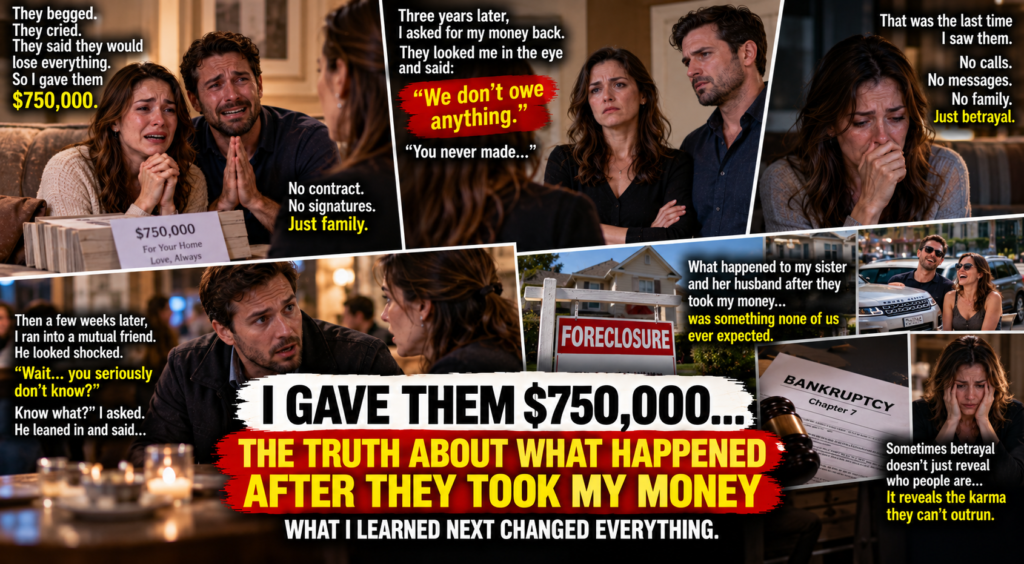
I Gave My Sister $750,000 — Then She Said We Never Owed Her Anything
I lent my sister and her husband $750,000 to save their home.
They cried.
They begged.
They said they would lose everything.
So I trusted them.
No contract.
No signatures.
Just family.
Three years later, I asked for my money back.
They looked me directly in the eyes and said:
“We don’t owe you anything.”
Silence.
Then my sister added:
“You never made us sign anything.”
That was the last time I saw them.
No calls.
No messages.
No family.
Just betrayal.
I spent weeks trying to understand how my own sister could look me in the face after everything I had done for her.
Then, a few weeks later, I ran into a mutual friend.
He looked shocked when he saw me.
“Wait…”
He stared at me.
“You seriously don’t know?”
My stomach dropped.
“Know what?”
He leaned closer.
“What happened to your sister and her husband…”
He paused.
“…after they took your money.”
I froze.
Because what he told me next changed everything.
My sister, Rachel, had always been the person in our family who seemed to have everything.
Beautiful house.
Nice cars.
Expensive vacations.
Perfect photographs on social media.
Her husband, Michael, owned a construction company.
At least, that’s what everyone believed.
I lived a much quieter life.
I worked hard.
Saved carefully.
Invested my money.
I wasn’t rich enough to show off.
But I was financially secure.
Then one afternoon, Rachel called me crying.
“Please come over.”
I knew immediately something was wrong.
When I arrived at her house, she was sitting at the kitchen table.
Michael was beside her.
Both of them looked exhausted.
“What happened?”
Rachel started crying.
“We’re going to lose the house.”
I looked at Michael.
“What do you mean?”
His construction company had suffered a series of losses.
Several projects had gone badly.
He had borrowed money to keep the business alive.
Then the bank demanded repayment.
Their house had been used as collateral.
If they couldn’t pay, the bank would foreclose.
“How much do you need?”
Michael gave me the number.
$750,000.
I nearly fell out of my chair.
“That’s impossible.”
“I know.”
Rachel grabbed my hand.
“Please.”
I looked at her.
“We’ve tried everything.”
“We’ll lose our home.”
“Our kids will have nowhere to live.”
“We’ll lose everything.”
I spent that night thinking.
I had the money.
It was money I had saved for years.
I didn’t need all of it immediately.
And this was my sister.
So the next morning, I transferred the $750,000.
No lawyer.
No contract.
No repayment schedule.
Just family.
Rachel hugged me so tightly she could barely speak.
“You saved us.”
Michael shook my hand.
“I’ll never forget this.”
I believed him.
I really did.
For the first year, everything seemed fine.
They kept their house.
Michael’s business recovered.
Rachel sent me photographs of family vacations.
They bought new furniture.
They renovated the kitchen.
I was happy for them.
I didn’t ask about the money.
I trusted them.
The second year passed.
Still nothing.
Then the third year arrived.
By then, I needed the money.
Not because I was desperate.
Because I had plans.
I wanted to buy a house of my own.
So I called Rachel.
“Hey, I think it’s time we talk about the loan.”
There was silence.
“What loan?”
I laughed.
“Very funny.”
She didn’t laugh.
“What are you talking about?”
“The $750,000.”
Another silence.
Then she said:
“Oh.”
That single word made my stomach tighten.
“Yeah. The money I gave you three years ago.”
She sighed.
“We’ve already talked about this.”
“No, we haven’t.”
“Yes, we have.”
“I don’t think we have.”
She became irritated.
“You gave us that money.”
“Yes.”
“You never made us sign anything.”
I stared at the phone.
“I didn’t think I needed to.”
“Then that’s your problem.”
I couldn’t believe what I was hearing.
“Rachel…”
“We don’t owe you anything.”
I thought she was joking.
She wasn’t.
Then Michael got on the phone.
“Look, we appreciate what you did.”
“Appreciate?”
“Yes.”
“But it was a gift.”
“No.”
“You said it was a loan.”
“We never agreed to a repayment date.”
“You said you would pay me back.”
“Did we sign anything?”
“No.”
“Then there’s nothing to discuss.”
The call ended.
I sat at my kitchen table for nearly an hour.
I couldn’t understand it.
This wasn’t a stranger.
This wasn’t a business partner.
This was my little sister.
The person I had grown up with.
The person I had protected.
The person I had just saved from losing her home.
And now she was telling me the money was hers.
I called again.
No answer.
I sent a message.
Nothing.
Another.
Nothing.
Then I realized something.
They hadn’t just refused to repay me.
They had erased me.
I was blocked.
My number.
My social media.
Everything.
For three years, I had thought I was helping family.
Now I realized I had helped people who were willing to destroy the relationship the moment money became involved.
I decided to speak with an attorney.
The first thing he asked was:
“Do you have proof you transferred the money?”
“Yes.”
“Do you have messages showing it was a loan?”
I showed him everything I had.
Bank records.
Text messages.
Emails.
Photographs.
Old conversations.
He studied them carefully.
“This may be more complicated without a written agreement.”
“I know.”
“But complicated doesn’t necessarily mean impossible.”
I handed him one particular message.
It was from Rachel.
Three years earlier.
The day after I transferred the money.
“Thank you for lending us the $750,000. We promise we’ll pay you back as soon as we’re stable.”
My attorney looked at me.
“This is important.”
I nodded.
“I thought so.”
He smiled slightly.
“So did I.”
But before we could do anything, I ran into our mutual friend.
His name was Daniel.
He looked at me like he had just seen a ghost.
“Wait…”
“What?”
“You seriously don’t know?”
“Know what?”
He lowered his voice.
“What happened to Rachel and Michael after they took your money?”
I stared at him.
“What happened?”
He shook his head.
“They lost the house anyway.”
I felt confused.
“What?”
“About six months after you gave them the money, Michael’s company collapsed.”
I froze.
“But they kept the house.”
“For a while.”
“What happened?”
Daniel told me that Michael had used the money I gave them to pay off the immediate bank debt.
But instead of fixing the underlying financial problems, he had continued borrowing.
He had taken out new loans.
Used credit lines.
Signed bad contracts.
And eventually, the company went bankrupt.
The house was seized.
Their cars were repossessed.
Their business disappeared.
And Rachel and Michael moved out of state.
I stared at Daniel.
“When?”
“Months ago.”
“Where?”
He gave me an address.
Then he said:
“But that’s not the part I don’t understand.”
“What?”
“Why didn’t they tell you?”
I almost laughed.
“I think we both know why.”
Daniel looked uncomfortable.
“No.”
He shook his head.
“You don’t.”
“What do you mean?”
He pulled out his phone.
“I have something.”
He showed me a photograph.
Rachel and Michael standing outside a beautiful new house.
I stared at it.
“This was taken last month.”
My stomach dropped.
“What?”
“They didn’t lose everything.”
I stared at the picture.
The house looked enormous.
A new car sat in the driveway.
They were smiling.
“How?”
Daniel sighed.
“They sold the house you helped save.”
I couldn’t speak.
“They sold it before the bank could take it.”
“And the money?”
“They used it to settle some debts.”
I nodded slowly.
“So they still had money.”
“Yes.”
“Then why did they tell me they couldn’t repay me?”
Daniel looked at me.
“Because they didn’t want to.”
That sentence hurt more than anything.
Not because I had lost $750,000.
Because I finally understood the betrayal.
They weren’t unable to repay me.
They had decided they didn’t have to.
Then Daniel showed me something else.
A photograph of a document.
It was a property purchase.
The buyer’s name was Rachel.
The house was in another state.
They had bought it months after telling me:
“We don’t owe you anything.”
I felt something inside me go quiet.
I had been mourning my sister.
But the sister I remembered had probably been gone for years.
I gave the evidence to my attorney.
He filed the necessary claim.
Rachel and Michael were forced to respond.
Suddenly, they called.
Rachel’s number appeared on my phone.
I stared at it.
I almost didn’t answer.
Then I did.
“Hello?”
“Why are you doing this?”
I couldn’t believe her question.
“Why am I doing what?”
“Trying to take our house.”
“I gave you $750,000.”
“You gave us that money.”
“As a loan.”
“You have no right.”
“You said you’d pay me back.”
“You never made us sign anything.”
I closed my eyes.
“I have your message.”
Silence.
“What message?”
“The one where you thanked me for lending you the money and promised to repay it.”
She didn’t answer.
Then Michael came on the line.
“Look, we can work something out.”
“Now you want to work something out?”
“We’ve had financial problems.”
“You bought a new house.”
Silence.
“How do you know?”
“Because your friend showed me.”
He cursed under his breath.
Then I said:
“You didn’t lose everything.”
“No.”
“You just wanted me to believe you did.”
He didn’t answer.
I continued:
“You didn’t need my money.”
“You needed someone willing to trust you.”
“And I was that person.”
There was a long silence.
Then Rachel began crying.
“I didn’t think you’d take it this far.”
I answered quietly:
“I didn’t think you’d take it this far either.”
The legal process lasted almost a year.
There were arguments over whether the money was a loan or a gift.
But the evidence mattered.
The transfer records.
The messages.
Their original statements.
Their financial documents.
And the fact that they had acknowledged the debt in writing.
Eventually, we reached a settlement.
I didn’t recover every dollar.
But I recovered a substantial portion.
Enough to rebuild what I had lost.
Enough to buy the house I had originally planned to purchase.
But by then, I didn’t care about the house.
I cared about something else.
Closure.
The day the settlement was finalized, Rachel asked to see me.
I agreed.
We met at a quiet café.
She looked older.
Tired.
Not because of age.
Because guilt changes people’s faces.
She sat across from me.
“I was wrong.”
I didn’t answer.
“I thought if I admitted we owed you, we’d lose everything.”
“You had already lost everything.”
She looked down.
“I was scared.”
“So you decided to make me pay for it.”
She began crying.
“I was selfish.”
“Yes.”
She nodded.
“I know.”
I looked at her.
“Do you know what hurt the most?”
She shook her head.
“It wasn’t the money.”
“What was it?”
“You made me regret trusting my own sister.”
She cried harder.
“I wish I could change that.”
“So do I.”
We sat silently.
Then she asked:
“Can you ever forgive me?”
I thought for a long time.
“I can forgive you.”
She looked up.
“But that doesn’t mean I can trust you again.”
She nodded.
“I understand.”
I stood.
“Take care of yourself.”
She whispered:
“You too.”
That was the last time we spoke.
I bought my house six months later.
It wasn’t as big as Rachel’s old house.
It didn’t need to be.
It was mine.
No debt to anyone.
No family arguments.
No promises written in invisible ink.
Just peace.
I framed one thing and hung it in my office.
Not the settlement.
Not the bank statement.
Not the photograph of their new house.
The message Rachel had sent me three years earlier:
“Thank you for lending us the $750,000. We promise we’ll pay you back.”
I kept it because it reminded me of something important.
Trust is valuable.
But trust doesn’t mean you shouldn’t protect yourself.
Family is important.
But family doesn’t make someone automatically honest.
And kindness should never require you to abandon common sense.
If I could go back, I would still help my sister.
But I would put the agreement in writing.
I would hire a lawyer.
I would set a repayment schedule.
And I would make sure everyone understood exactly what the money was.
Because protecting yourself doesn’t mean you don’t love your family.
Sometimes, it means you love yourself enough to protect the relationship from money.
Years later, I heard that Rachel and Michael had separated.
Their new house was eventually sold.
The construction company was gone.
Their marriage didn’t survive the financial collapse.
I didn’t celebrate.
I didn’t feel victorious.
I simply felt sad.
Because none of it had to happen.
They could have told me the truth.
They could have asked for more time.
They could have admitted they couldn’t repay me immediately.
I might have understood.
Instead, they chose denial.
And denial cost them much more than $750,000.
It cost them a sister.
A family.
And the trust of the people who once loved them most.
Sometimes people think the worst thing about betrayal is losing what you gave.
It isn’t.
The worst part is realizing the person you helped never saw your kindness as love.
They saw it as an opportunity.
And that’s a lesson I will never forget.
I once thought the $750,000 was the biggest thing I had given my sister.
I was wrong.
The biggest thing I gave her was trust.
And once she broke that…
there was no amount of money in the world that could buy it back.
Because money can be earned again.
Houses can be rebuilt.
Accounts can recover.
But once someone teaches you that your kindness can be used against you…
you never look at them the same way again.
So if someone you love ever asks you for a life-changing amount of money, don’t be afraid to put everything in writing.
A contract doesn’t mean you don’t trust them.
It means you’re protecting both of you.
Because the right family member won’t be offended by documentation.
They’ll understand.
And if someone says:
“If you really loved me, you wouldn’t need a contract…”
remember this story.
Because sometimes the person asking you not to put it in writing…
already knows exactly why they don’t want you to.