My Mom Left Me Her Plant — Then Her Note Told Me to Search the Soil
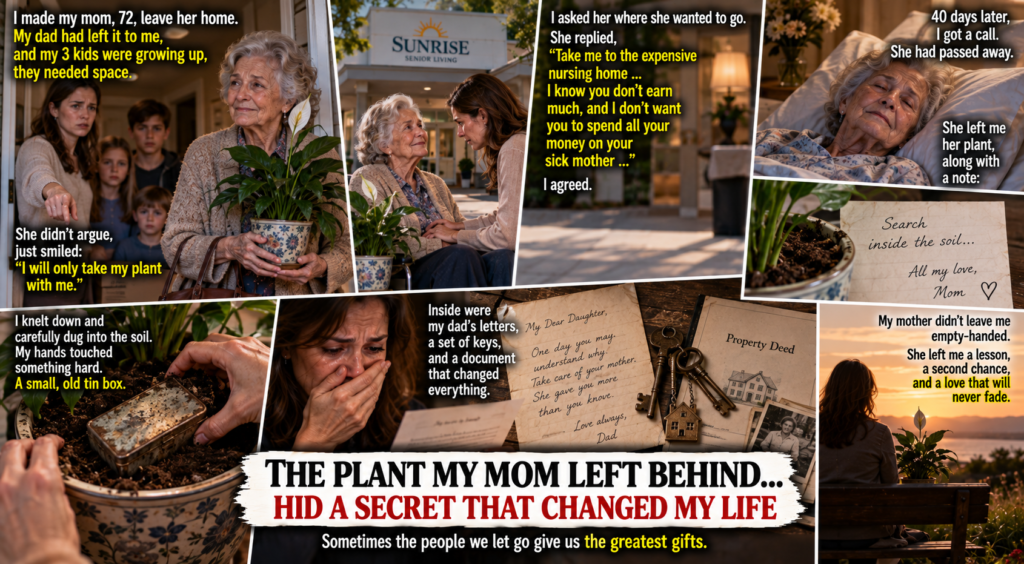
I made my mom, 72, leave her home.
My dad had left the house to me before he died.
My three kids were growing up, and they needed more space.
At first, I told myself it made sense.
The house was large, and my children needed their own rooms.
My husband and I were struggling financially.
And my mother had been sick for months.
I told myself I was doing what was best for everyone.
But deep down, I knew the truth.
I wanted the house.
And I didn’t want to admit it.
My mother didn’t argue.
She didn’t yell.
She didn’t ask me how I could do this to her.
She simply looked around the house one last time.
Then she smiled sadly.
“I will only take my plant with me.”
I looked at the old plant sitting beside the living-room window.
It was a large green plant in a heavy ceramic pot.
I’d seen it there for as long as I could remember.
“That’s all?”
She nodded.
“That’s all.”
I asked her where she wanted to go.
She looked at me and said:
“Take me to the expensive nursing home.”
I stared at her.
“Mom, that’s expensive.”
“I know.”
“You don’t have to go there.”
She smiled.
“I know you don’t earn much, and I don’t want you to spend all your money on your sick mother.”
I felt guilty.
But I agreed.
The nursing home was beautiful.
It had a garden.
Private rooms.
Nurses available around the clock.
My mother seemed comfortable there.
Before she went inside, she turned toward me.
“Don’t worry about me.”
I hugged her.
“I’ll visit tomorrow.”
She smiled.
“I know you will.”
I left.
I didn’t know that would be one of the last times I would see her alive.
For the first few days, I visited every afternoon.
I brought her food.
My children drew pictures for her.
She always asked about them.
“How’s Emma?”
“She’s doing well.”
“And the boys?”
“Running around the house as usual.”
My mother laughed.
“Good.”
She never complained about the nursing home.
She never complained about me.
She never asked about the house.
Not once.
On the seventh day, I arrived and found her asleep.
I sat beside her.
She looked peaceful.
I held her hand.
“Mom?”
She opened her eyes.
“Hi, sweetheart.”
“How are you feeling?”
“Tired.”
“Do you need anything?”
She shook her head.
“I have everything I need.”
I kissed her forehead.
Then she looked at me.
“Take care of my plant.”
I smiled.
“I will.”
She closed her eyes.
I thought she was going to sleep.
I didn’t realize she was saying goodbye.
Forty days after I moved her into the nursing home, I received a phone call.
The woman on the other end spoke gently.
“I’m so sorry.”
I knew before she finished.
My mother was gone.
I drove there immediately.
I held her hand.
The same hand I had held so many times as a child.
And for the first time, I realized how much I had taken her presence for granted.
I cried until I couldn’t breathe.
I kept thinking:
I should have visited more.
I should have called more.
I should have listened more.
I should have told her I loved her.
But there was nothing I could do anymore.
After the funeral, the nursing home gave me her belongings.
There wasn’t much.
A few clothes.
A photograph of my father.
A Bible.
And the plant.
I carried it home.
I placed it beside the window.
It looked exactly as it had in my parents’ house.
For several days, I couldn’t bring myself to touch it.
Then I noticed something taped to the pot.
A small envelope.
My name was written on it.
My hands began to shake.
I opened it.
Inside was a note.
Only one sentence.
Search inside the soil.
I stared at the words.
I almost laughed.
“What could possibly be in the soil?”
Then I remembered my mother’s face when she said:
“Take care of my plant.”
I brought the pot outside.
I put on a pair of gloves.
Then I carefully began removing the soil.
Nothing.
More soil.
Nothing.
I kept digging.
Then my fingers hit something hard.
I stopped.
My heart began pounding.
I carefully moved the soil aside.
There was a small metal box buried beneath the roots.
It was old.
Rusty.
About the size of a book.
I pulled it out.
My hands were shaking.
There was a tiny key taped to the bottom of the plant pot.
I unlocked the box.
Inside were documents.
Photographs.
A bundle of letters.
And a second envelope.
This one said:
For my daughter. Read this before you make any decisions about the house.
I froze.
The house.
I opened the letter.
My dear daughter,
If you are reading this, then I am no longer there to explain everything myself.
I had to stop.
Tears filled my eyes.
I continued.
First, I want you to know that I never blamed you for asking me to leave the house.
I started crying.
I know you believed you were doing what was best for your children.
I know you were worried about money.
And I know you were afraid that taking care of me would become a burden.
I covered my mouth.
She knew.
She had understood everything.
Even the things I hadn’t admitted to myself.
Then I read the next paragraph.
But there is something about your father’s house that you don’t know.
I looked up at the house.
My heart began racing.
Your father didn’t leave that house to you because he wanted you to own it.
He left it to you because he wanted you to protect it.
I stared at the page.
Protect it?
From what?
Then I found another document.
It was the original property deed.
I read it carefully.
My father had indeed left the house to me.
But there was a clause I had never seen.
The property was connected to a trust.
My father had created it years before he died.
I kept reading.
The house wasn’t simply an inheritance.
It was meant to remain in the family.
And there was another beneficiary.
My children.
My mother’s letter explained everything.
Your father knew that one day you might feel pressure to sell the house.
He knew you would need money.
He knew life would become difficult.
So he created the trust to make sure the house could never simply become another possession to be sold when things got hard.
I sat on the ground.
I had almost made the biggest mistake of my life.
I had forced my mother out of the home that my father had intended to remain in the family.
Then I found another document.
A bank statement.
There was money in the trust.
A lot of money.
My father had quietly invested part of his business earnings years earlier.
The account had continued growing.
My mother had access to it.
But she had never touched it.
Why?
I read the letter.
Because that money belongs to your children.
Not to me.
Not to you.
To them.
I started crying again.
My mother had been struggling with medical expenses.
She had been living in a nursing home.
And she had never touched the money.
She had chosen to protect my children instead.
Then I found another letter.
This one was from my father.
It was written shortly before he died.
If our daughter ever struggles, help her without letting her know where the help came from.
She is proud.
She will refuse if she knows.
I laughed through my tears.
That sounded exactly like my father.
Then came the final sentence.
And if she ever sends you away because she thinks you are a burden, don’t fight her.
Give her the plant.
I stopped breathing.
The plant.
My mother had known.
She had planned everything.
The plant wasn’t just a plant.
It was the key to the truth.
I called the attorney whose name appeared on the documents.
He confirmed everything.
The trust was legitimate.
The property was protected.
And the money in the account was intended to help my children with education and future expenses.
But there was something else.
My mother had left instructions.
If I discovered the box, I was supposed to receive another envelope.
The attorney mailed it to me.
I opened it that night.
Inside was a final letter.
My sweetheart,
You may be angry with yourself.
Please don’t be.
I knew you were tired.
I knew you were scared.
I knew you thought putting me in a nursing home was the responsible thing to do.
I also knew that one day you would understand.
I wiped away my tears.
I didn’t leave the house because I was unwanted.
I left because I wanted you to understand something.
A mother doesn’t measure love by the size of the room she sleeps in.
She measures it by what she leaves behind for her children.
I couldn’t stop crying.
Then I reached the final paragraph.
You said you couldn’t afford to take care of your sick mother.
You were wrong.
You simply didn’t know that I had already spent my whole life taking care of you.
Now it was my turn to take care of you one last time.
I pressed the letter against my chest.
The next morning, I went back to the house.
My children were playing in the backyard.
I looked around.
The rooms felt different.
The house wasn’t just mine.
It belonged to their future too.
I walked to the window where my mother’s plant had stood for decades.
I touched its leaves.
Then I remembered something.
My mother had never asked for the house.
She could have fought me.
She could have reminded me that she had lived there for decades.
She could have told me I was selfish.
Instead, she had simply said:
“I will only take my plant with me.”
She knew I would eventually understand why.
That afternoon, I called my children into the living room.
“Grandma left you something.”
They looked confused.
“What?”
I showed them the documents.
They didn’t understand the money or the trust.
They were too young.
So I told them something simpler.
“Grandma wanted to make sure you always had a safe future.”
My youngest asked:
“Is she coming back?”
My heart broke.
“No, sweetheart.”
He looked down.
“Then why did she leave her plant?”
I smiled through my tears.
“Because she wanted us to remember her.”
He touched one of the leaves.
“Can we keep it?”
“Yes.”
“We have to take care of it?”
“Yes.”
He smiled.
“Then I’ll water it.”
I laughed.
“Okay.”
Years passed.
The plant grew.
My children grew.
And the house remained in the family.
Every Saturday morning, I watered the plant.
Sometimes my children helped.
Eventually, they learned the whole story.
They learned about their grandmother.
About their grandfather.
About the trust.
About the letters.
About the little metal box hidden beneath the soil.
And they learned something much more important.
That love isn’t always loud.
Sometimes love looks like giving someone space.
Sometimes it looks like stepping away without complaining.
Sometimes it looks like pretending you don’t need help because you want your child to keep her money.
And sometimes…
love looks like hiding the greatest gift you’ve ever given someone underneath the soil of an ordinary plant.
Years later, when my oldest daughter was preparing to leave for college, she stood beside the plant.
“Mom?”
“Yes?”
“Do you ever regret making Grandma leave?”
I looked at the leaves.
“Yes.”
She nodded.
“But Grandma forgave you?”
I smiled.
“She never blamed me.”
“Why?”
“Because she understood me better than I understood myself.”
My daughter was quiet for a moment.
Then she said:
“I wish I could have known her longer.”
I put my arm around her.
“So do I.”
She touched the plant.
“I’m glad she left this.”
“So am I.”
I still think about those forty days.
Forty days between the day I sent my mother to the nursing home and the day she died.
Forty days that I thought were the end.
But they weren’t.
They were her final gift to me.
She left me more than money.
She left me forgiveness.
She left me the truth.
She left me a lesson I will carry for the rest of my life.
I thought I had forced my mother out because my children needed space.
But my mother never saw herself as being pushed out.
She saw an opportunity to protect us one last time.
She didn’t leave with suitcases full of possessions.
She didn’t ask for furniture.
She didn’t take jewelry.
She didn’t take photographs.
She took one plant.
And buried beneath its soil was everything she had been trying to tell me.
My father had planned for our future.
My mother had protected it.
And I had nearly thrown it away because I was too worried about the present to understand the sacrifice my parents had made for the future.
Today, the plant is still alive.
It’s older now.
Some leaves have turned yellow.
We’ve had to repot it several times.
But we never throw it away.
Because it isn’t just a plant anymore.
It’s my mother’s final message.
Every time I water it, I remember her.
Every time a new leaf appears, I think about the way she always believed something better was coming.
And every time I look at that little metal box, I remember the words she left me:
“I didn’t leave because you didn’t want me.”
“I left because I wanted you to have everything you needed to keep going.”
I once thought I had made my mother leave her home.
Now I understand.
She was never really leaving.
She was leaving something behind.
Something much bigger than a house.
She was leaving a future.
She was leaving forgiveness.
She was leaving a reminder that parents sometimes sacrifice in ways their children don’t understand until it’s too late.
And she was leaving me one final lesson:
Never mistake someone’s quietness for weakness.
Never mistake their sacrifice for indifference.
And most importantly…
Never wait until someone is gone to tell them how much they mean to you.
Because sometimes the person who says:
“I’ll only take my plant…”
is actually leaving you the greatest part of everything they ever had.
And sometimes…
you don’t discover what they left behind until you finally take the time to search beneath the surface.