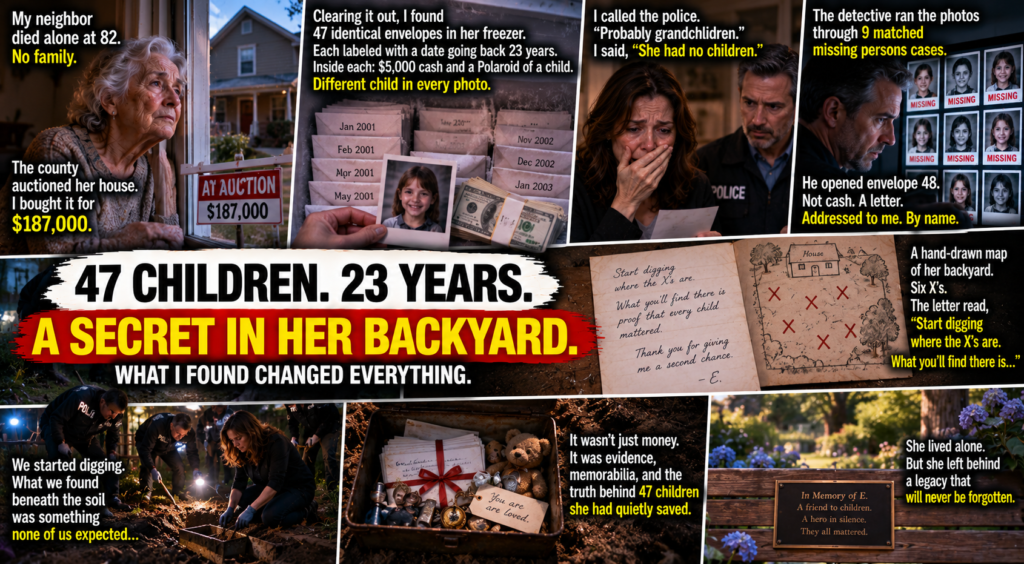
I Bought My Neighbor’s House for $187,000 — Then Found 47 Envelopes in Her Freezer
My neighbor died alone at 82.
No husband.
No children.
No siblings anyone in the neighborhood knew about.
Just an old house at the end of our street, a garden that had slowly disappeared beneath weeds, and a mailbox that hadn’t been opened in months.
When the county auctioned the property, I bought it for $187,000.
I thought I was getting an old house that needed work.
I had no idea I was buying the final chapter of a secret that had been kept for twenty-three years.
Her name was Evelyn.
She had lived next door to me for almost fifteen years.
We weren’t close friends exactly, but we were friendly.
She waved whenever I drove past.
She brought cookies over at Christmas.
Sometimes we’d sit on her porch and talk about the weather.
She never talked about family.
When I once asked whether she had children, she simply smiled and said, “No, dear. It’s just me.”
I never questioned it.
After she died, the county cleared everything that had obvious value.
The rest was left to the auction buyer.
That was me.
For the first two days, I mostly found ordinary things.
Old furniture.
Tax papers.
Photographs.
Kitchen dishes.
A stack of newspapers tied with string.
Then I opened the basement freezer.
There were dozens of envelopes inside.
At first, I thought they were frozen food labels.
Then I picked one up.
It had a date written on it.
March 14, 2001.
I opened it.
Five thousand dollars in cash fell into my hands.
And underneath the money was a Polaroid photograph.
A child.
A little girl, maybe eight years old.
She was smiling at the camera.
On the back of the photograph was a name.
Emily.
I froze.
I opened another envelope.
Another $5,000.
Another child.
A little boy.
Different name.
Different photograph.
Different date.
I opened a third.
Then a fourth.
Then a fifth.
By the time I stopped counting, there were 47 envelopes.
Each one contained exactly $5,000.
Each one contained a photograph of a different child.
And the dates went back twenty-three years.
My hands started shaking.
I called the police.
When the detective arrived, I laid everything across the kitchen table.
He stared at the envelopes.
Then at me.
“Did Evelyn have grandchildren?”
“No.”
“Any children?”
“No.”
“Are you sure?”
“I knew her for fifteen years. She told me she had no children.”
The detective picked up one of the photographs.
“Maybe they were children she sponsored.”
“I don’t know.”
He studied another photo.
Then another.
“Don’t touch anything else.”
He called for additional officers.
Within an hour, Evelyn’s quiet little house was full of people.
The photographs were photographed.
The money was counted.
The envelopes were cataloged.
Then the detective ran the children’s names and photographs through missing-person databases.
At first, nothing happened.
Then his phone rang.
He walked into the hallway.
When he came back, his expression had changed.
“We have a match.”
I felt my stomach drop.
He held up the first photograph.
“This child was reported missing in 2001.”
He placed another photo beside it.
“Same thing here.”
Then another.
And another.
Within hours, nine of the photographs matched missing-person cases.
Nine children.
Nine families.
Nine disappearances.
And Evelyn had kept their photographs.
And $5,000 for each one.
The detective looked at me.
“Where’s the rest of the money?”
“I don’t know.”
He looked back at the freezer.
“Neither do I.”
Then he noticed something.
There were 48 slots in the freezer.
But only 47 envelopes.
He pulled out the empty space.
Behind it was another envelope.
This one wasn’t dated.
And it didn’t contain money.
It contained a letter.
My name was written on the front.
Not “To the new owner.”
Not “To whoever finds this.”
My actual name.
To Sarah.
I couldn’t breathe.
“How did she know I’d buy the house?”
The detective looked at me.
“We’re about to find out.”
He opened the envelope.
Inside was a single sheet of paper.
The handwriting was Evelyn’s.
I recognized it immediately.
The letter began:
Sarah,
If you’re reading this, then I’m gone.
My eyes filled with tears.
I continued.
I knew there was a chance you would be the one to buy this house. You were the only neighbor who ever asked me if I needed anything without asking what I could give you in return.
I looked at the detective.
Neither of us spoke.
Then I read the next line.
Please don’t call the police again until you finish reading this.
My heart started pounding.
Below that was a hand-drawn map of Evelyn’s backyard.
Six red X’s were marked across the property.
Underneath the map, she had written:
Start digging where the X’s are.
And then:
What you’ll find there is proof that every one of those children mattered.
The detective immediately shook his head.
“No digging until we get a warrant.”
So we waited.
The next morning, officers arrived with equipment.
We started with the first X.
Six inches down, we hit a metal box.
Inside was a collection of children’s belongings.
A shoe.
A stuffed rabbit.
A school photograph.
A hospital bracelet.
A birthday card.
Each item had a name attached.
The second X contained another box.
The third contained another.
By the fourth, we understood.
Evelyn had been collecting evidence.
Not evidence of crimes.
Evidence of lives.
Every box belonged to a child whose photograph had been stored in the freezer.
The detective found something else.
A stack of letters.
Some were written by parents.
Some by social workers.
Some by children.
One was written in crayon.
The first line said:
Dear Miss Evelyn, I don’t know if you will ever get this, but thank you for finding me.
The detective sat down.
For several minutes, nobody spoke.
Then he finally explained what Evelyn had been doing.
Twenty-three years earlier, Evelyn had volunteered with a nonprofit organization that helped locate missing children.
She wasn’t a police officer.
She wasn’t a detective.
She was simply a retired school counselor who had a talent for finding people who had fallen through the cracks.
Some of the children had been runaways.
Some had been taken by relatives.
Some had been victims of exploitation.
Some had simply disappeared from unstable homes.
Evelyn had helped locate them.
But she had discovered something heartbreaking.
Finding a child was only the beginning.
Many of them had nowhere safe to go.
So she began using her own money.
Five thousand dollars at a time.
She helped pay for temporary housing.
Medical care.
School supplies.
Transportation.
Legal assistance.
Sometimes, she simply gave a family enough money to survive another month.
The photographs were her way of remembering every child she had helped.
But there was something the detective couldn’t explain.
“Why hide the money in the freezer?”
I found the answer in another letter.
Evelyn had written:
People notice a safe.
People notice a bank account.
Nobody searches beneath frozen peas.
I almost laughed.
Even at eighty-two, Evelyn had apparently still been smarter than everyone around her.
Then I found the final paragraph of her letter to me.
It explained the $5,000 in every envelope.
The money wasn’t meant for the children in the photographs.
It was meant for me.
I read the sentence twice.
Then a third time.
The money in those envelopes is yours.
I stared at the detective.
“What?”
He read the letter.
Evelyn explained that she had spent most of her savings helping children.
But she had kept one final fund untouched.
She had invested it quietly over the years.
The $235,000 in the freezer was what remained.
She knew she was getting old.
She knew she might never have children of her own.
And she knew that one day someone would buy her house.
She wante