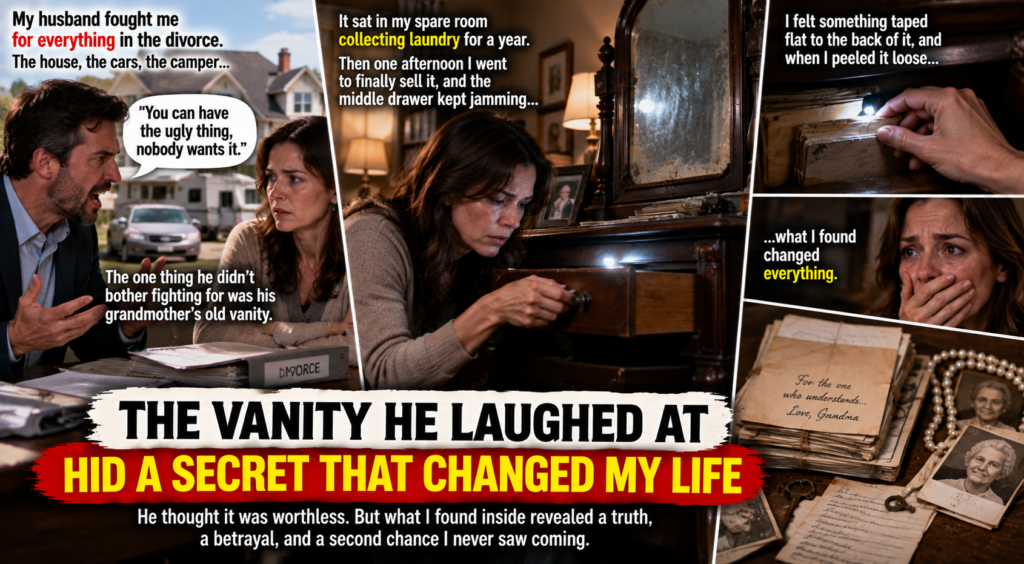
My Husband Didn’t Want His Grandmother’s Ugly Vanity
My husband fought me for everything in the divorce.
The house.
The cars.
The camper we had used maybe twice.
By the end, I just wanted it over.
So I let him have it.
The one thing he didn’t bother fighting for was his grandmother’s old vanity.
That heavy, dark thing with the cloudy mirror that had sat in their hallway forever.
He actually laughed when the movers took it.
“You can have the ugly thing. Nobody wants it.”
I didn’t argue.
The vanity wasn’t worth much.
At least, that’s what I thought.
It sat in my spare room collecting laundry for the better part of a year.
Sometimes I’d throw a basket of clothes on top of it.
Sometimes I used one of the drawers for spare batteries.
I barely noticed it anymore.
Until one afternoon, I decided to finally sell it.
I wiped the dust from the mirror.
Then I pulled open the drawers.
The top drawer opened easily.
The bottom one did too.
But the middle drawer wouldn’t move.
I pulled harder.
Nothing.
I tried again.
It moved about an inch and stopped.
Like something was catching behind it.
I crouched down.
I shined a flashlight into the gap.
Nothing.
Then I reached my hand behind the drawer.
My fingers touched something.
Flat.
Thin.
And taped tightly to the back of the drawer.
I pulled it loose.
It was a small brown envelope.
My name was written on it.
Not my ex-husband’s.
Mine.
I froze.
The handwriting looked old.
Careful.
Deliberate.
Under my name were four words:
“For you, when needed.”
I sat on the floor.
I had never seen the envelope before.
And I knew exactly whose handwriting it was.
Margaret.
My ex-husband’s grandmother.
She had died seven years earlier.
I opened the envelope.
Inside was a handwritten letter.
The first line made my heart stop.
Dear Emily,
If you are reading this, then something has happened that I prayed never would.
I kept reading.
You may not understand why this letter is hidden inside the vanity.
You may not even understand why I’m giving something to you instead of my grandson.
I stared at the page.
Then came the sentence that changed everything.
Because I have watched him become someone I no longer recognize.
I stopped.
My hands began shaking.
I read the next paragraph.
Margaret explained that she had noticed things long before I did.
She had seen how my husband, Mark, treated me.
She had noticed the way he talked about money.
The way he believed everything belonged to him.
The way he expected me to compromise while he never did.
But she had also noticed something else.
Something I had never known.
She had suspected that Mark was hiding money.
A lot of money.
I read faster.
I believe Mark is planning to leave you with far less than you deserve.
My stomach tightened.
That was exactly what had happened.
During the divorce, Mark had fought over every major asset.
He claimed the house.
He fought over the cars.
He wanted the camper.
He even argued over furniture.
But he never mentioned the vanity.
Margaret knew he wouldn’t.
Because Mark had always hated it.
She continued:
He thinks the vanity is worthless.
That’s why I chose it.
I stared at the old piece of furniture.
There was something hidden inside.
Something Margaret wanted me to find.
I immediately searched the vanity again.
I removed every drawer.
Checked underneath.
Behind the mirror.
Along the back panel.
Nothing.
Then I noticed something strange.
The cloudy mirror wasn’t attached normally.
I carefully pushed against one corner.
It moved.
Behind it was a narrow compartment.
Inside was a small metal box.
I opened it.
There were documents.
Bank statements.
Property records.
Old photographs.
And a key.
But the first document I saw made me stop breathing.
It was an account statement.
The account belonged to Margaret.
The balance was enormous.
I stared at the number.
Then I found another document.
A trust agreement.
I read the beneficiary section.
My name was there.
I sat down.
Margaret had left me money.
But why?
I kept reading.
The trust had been established years before my marriage to Mark.
It wasn’t part of our marital property.
It was specifically designated for me.
Not Mark.
Not his parents.
Me.
I couldn’t understand it.
Then I found another letter.
This one was dated two years before Margaret died.
Emily,
I know you may be wondering why I’m doing this.
The answer is simple.
You were the only person who treated me like a person instead of an inheritance.
I remembered that.
When Mark and I were dating, Margaret had been living alone.
Her health wasn’t good.
Mark visited when he needed something.
Money.
Advice.
Documents.
But I visited her just to sit with her.
We drank tea.
We watched old movies.
She told me stories about Mark when he was little.
She once told me:
“You’re the first person in this family who doesn’t look at me and see a bank account.”
At the time, I laughed.
I thought she was joking.
She wasn’t.
The letter continued.
I know what my grandson is capable of.
And I know he may one day choose money over loyalty.
If that day comes, don’t let him convince you that you are worth less than what he can take from you.
I started crying.
But then I found something even more shocking.
A folder labeled:
MARK — FINANCIAL RECORDS
Inside were copies of bank transfers.
Payments.
Investment accounts.
And a series of transfers from our joint account into an account I had never seen.
The dates went back three years.
Mark had been moving money long before the divorce.
He had been preparing.
But there was one document that made everything even clearer.
A handwritten note from Margaret.
“If Mark ever tries to hide assets during a divorce, give these records to Emily’s attorney.”
I stared at the sentence.
Margaret had anticipated this.
She had known her grandson.
And she had protected me long before I realized I needed protection.
I called my divorce attorney.
“Can I come in?”
“Of course.”
“I found something.”
An hour later, I placed the documents on his desk.
He read through them carefully.
Then he looked at me.
“Where did you get these?”
“The vanity.”
He blinked.
“What vanity?”
I explained.
He shook his head.
“Emily, these records could be extremely important.”
“How?”
“These show transfers that may not have been disclosed during the divorce proceedings.”
I felt my heart pound.
“So the divorce isn’t over?”
“It can still be challenged if there was financial fraud or nondisclosure.”
I looked down.
For the first time since the divorce began, I felt something I hadn’t felt in months.
Hope.
But I wasn’t interested in taking revenge.
I wanted the truth.
The attorney filed the appropriate motions.
The financial records were reviewed.
Mark was required to explain the transfers.
He couldn’t.
Some of the money had been moved through several accounts.
Some had been used to pay personal debts.
Some had been transferred to a separate investment account.
And one account contained money that had never been disclosed during the divorce.
The settlement was reopened.
Mark was furious.
He called me.
“What are you doing?”
“Nothing.”
“You’re trying to take more from me.”
“No.”
I said calmly:
“I’m trying to recover what you already took from me.”
“You got the house!”
“You wanted it.”
“I let you keep the vanity.”
I almost laughed.
“You did.”
“It’s worthless.”
I looked at the old piece of furniture.
“No, Mark.”
“You were wrong about that too.”
Silence.
Then he asked:
“What did you find?”
I smiled.
“Something your grandmother wanted me to have.”
His voice changed.
“My grandmother?”
“Yes.”
“What did she leave you?”
I didn’t answer.
He became angry.
“Emily!”
I hung up.
The legal process continued.
Eventually, the hidden funds were recognized.
Mark had to return a significant portion of the money.
The divorce settlement changed.
I didn’t get everything.
I didn’t want everything.
I simply got what was fair.
And somehow, the thing Mark had laughed at became the reason I finally received justice.
But there was still one mystery.
Why had Margaret left me the trust?
I returned to the vanity.
I found the key she had hidden.
The key belonged to a safety deposit box.
I took it to the bank.
Inside was another envelope.
This one was addressed to me.
You found it.
I smiled through my tears.
I knew you would.
The letter continued.
Emily,
If Mark has given you the vanity, then he has already made one of the biggest mistakes of his life.
He believes valuable things should be shiny, expensive, and easy to sell.
He never understood that the most valuable things are sometimes the ones people overlook.
Then she explained everything.
Years earlier, Margaret had sold a successful business she had built with her husband.
She had quietly invested the money.
The trust was part of her estate plan.
She could have left everything to Mark.
But she didn’t.
Because she had watched him grow into someone who measured people by what they could give him.
She wanted to reward the person who had shown her kindness when there was nothing to gain.
That person was me.
The final lines brought tears to my eyes.
I don’t know what your marriage will become.
I hope it lasts.
But if it doesn’t, remember this:
You were never the woman who wasn’t good enough for my grandson.
He was simply not the man good enough for you.
I sat in my car outside the bank and cried.
Not because of the money.
Because someone had seen me.
Someone had believed in me.
Even when I hadn’t yet learned to believe in myself.
Months later, I moved into a smaller house.
It was peaceful.
No arguments.
No legal paperwork on the kitchen table.
No one telling me what I deserved.
I kept the vanity.
I had it professionally restored.
The cloudy mirror was replaced.
The dark wood was polished.
The scratches remained.
I wanted them to.
They reminded me of everything it had survived.
One day, I invited my daughter over.